Have People Upload Files to Your Website Html
Introduction
The ability to upload files is a cardinal requirement for many web and mobile applications. From uploading your photo on social media to post your resume on a job portal website, file upload is everywhere.
Every bit a web developer, nosotros must know that HTML provides the back up of native file upload with a bit of help from JavaScript. With HTML5 the File API is added to the DOM. Using that, we tin read the FileList and the File Object within it. This solves multiple utilise-cases with files, i.e, load them locally or send over the network to a server for processing, etc.
In this article, we will discuss x such usages of HTML file upload back up. Hope yous observe it useful.
TL;DR
At any point in time, if you want to play with these file upload features, yous can find it from here,
- HTML File Upload Demo: https://html-file-upload.netlify.app/
The source lawmaking of the demo is in my Github repo. ✋ Feel free to follow every bit I keep the code updated with examples. Delight give a ⭐ if you find it useful.
- Source Lawmaking Repo: https://github.com/atapas/html-file-upload
1. Simple file upload
Nosotros can specify the input type as file to use the file uploader functionality in a web application.
<input type="file" id="file-uploader"> An input file type enables users with a button to upload one or more files. Past default, it allows uploading a single file using the operating system's native file browser.
On successful upload, the File API makes it possible to read the File object using simple JavaScript code. To read the File object, we demand to listen to the modify event of the file uploader.
First, become the file uploader instance by id,
const fileUploader = certificate.getElementById('file-uploader'); Then add a change event listener to read the file object when the upload completes. Nosotros go the uploaded file information from the event.target.files belongings.
fileUploader.addEventListener('alter', (result) => { const files = event.target.files; panel.log('files', files); }); Observe the output in the browser console. Annotation the FileList array with the File object having all the metadata data about the uploaded file.
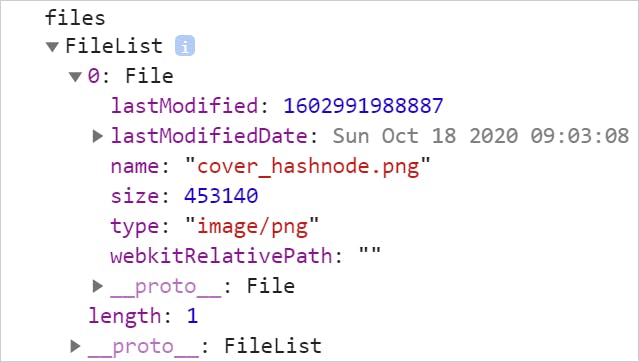
Here is the CodePen for you with the same example to explore further
2. Multiple file uploads
Nosotros tin upload multiple files at a time. To do that, we just need to add together an attribute called, multiple to the input file tag.
<input blazon="file" id="file-uploader" multiple /> Now, the file browser will allow y'all to upload one or more files to upload. Just like the previous example, you can add a change effect handler to capture the information well-nigh the files uploaded. Have you noticed, the FileList is an array? Right, for multiple file uploads the array volition accept data every bit,
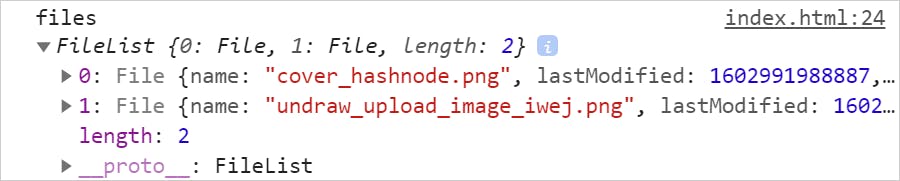
Here is the CodePen link to explore multiple file uploads.
Whenever we upload a file, the File object has the metadata information like file name, size, final update time, type, etc. This information can be useful for further validations, decision-making.
// Get the file uploader past id const fileUploader = certificate.getElementById('file-uploader'); // Listen to the change consequence and read metadata fileUploader.addEventListener('modify', (event) => { // Get the FileList assortment const files = event.target.files; // Loop through the files and get metadata for (const file of files) { const proper noun = file.name; const blazon = file.blazon ? file.type: 'NA'; const size = file.size; const lastModified = file.lastModified; panel.log({ file, proper name, type, size, lastModified }); } }); Hither is the output for single file upload,

Use this CodePen to explore farther,
4. Know most file accept property
We can use the take aspect to limit the type of files to upload. Yous may want to show just the allowed types of images to scan from when a user is uploading a profile picture.
<input blazon="file" id="file-uploader" have=".jpg, .png" multiple> In the lawmaking above, the file browser volition allow only the files with the extension jpg and png.
Note, in this case, the file browser automatically sets the file selection type as custom instead of all. Nevertheless, you can always modify it back to all files, if required.

Use this CodePen to explore the accept attribute,
5. Manage file content
Y'all may desire to show the file content after a successful upload of it. For profile pictures, it will be confusing if we practise not evidence the uploaded picture to the user immediately after upload.
We can use the FileReader object to catechumen the file to a binary string. Then add a load event listener to get the binary string on successful file upload.
// Get the instance of the FileReader const reader = new FileReader(); fileUploader.addEventListener('change', (event) => { const files = issue.target.files; const file = files[0]; // Get the file object after upload and read the // data as URL binary string reader.readAsDataURL(file); // One time loaded, do something with the string reader.addEventListener('load', (event) => { // Here we are creating an image tag and calculation // an image to it. const img = document.createElement('img'); imageGrid.appendChild(img); img.src = issue.target.issue; img.alt = file.name; }); }); Try selecting an paradigm file in the CodePen below and run into information technology renders.
half-dozen. Validate file size
Equally we have seen, we can read the size metadata of a file, we tin actually utilise it for a file size validation. You may let users to upload an paradigm file up to 1MB. Allow united states of america see how to achieve that.
// Listener for file upload change event fileUploader.addEventListener('alter', (outcome) => { // Read the file size const file = event.target.files[0]; const size = file.size; let msg = ''; // Check if the file size is bigger than 1MB and prepare a message. if (size > 1024 * 1024) { msg = `<bridge manner="colour:scarlet;">The allowed file size is 1MB. The file you are trying to upload is of ${returnFileSize(size)}</span>`; } else { msg = `<span fashion="colour:green;"> A ${returnFileSize(size)} file has been uploaded successfully. </span>`; } // Show the message to the user feedback.innerHTML = msg; }); Effort uploading a file of different sizes to see how the validation works,
seven. Bear witness file upload progress
The amend usability is to let your users know about a file upload progress. We are now enlightened of the FileReader and the issue to read and load the file.
const reader = new FileReader(); The FileReader has another event called, progress to know how much has been loaded. We tin can use HTML5'south progress tag to create a progress bar with this information.
reader.addEventListener('progress', (event) => { if (event.loaded && issue.full) { // Calculate the pct completed const percent = (consequence.loaded / event.total) * 100; // Set the value to the progress component progress.value = pct; } }); How about you endeavour uploading a bigger file and see the progress bar working in the CodePen below? Give it a try.
8. How about directory upload?
Can we upload an entire directory? Well, information technology is possible but with some limitations. In that location is a not-standard aspect(at least, while writing this article) called, webkitdirectory that allows us to upload an unabridged directory.
Though originally implemented merely for WebKit-based browsers, webkitdirectory is as well usable in Microsoft Border as well as Firefox fifty and later. Nevertheless, fifty-fifty though it has relatively wide support, it is nonetheless not standard and should non be used unless you have no alternative.
You can specify this attribute as,
<input type="file" id="file-uploader" webkitdirectory /> This volition allow you to select a folder(aka, directory),

User has to provide a confirmation to upload a directory,
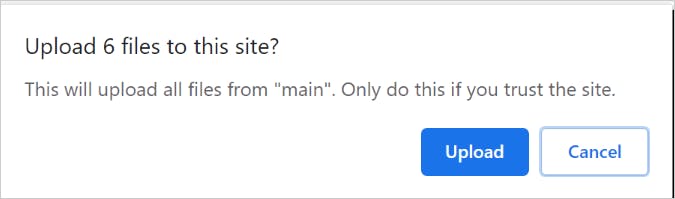
Once the user clicks the Upload button, the uploading takes place. One important point to note here. The FileList array will have information nearly all the files in the uploaded directory as a apartment structure. Only the key is, for each of the File objects, the webkitRelativePath attribute will have the directory path.
For instance, permit us consider a main directory and other folders and files nether it,
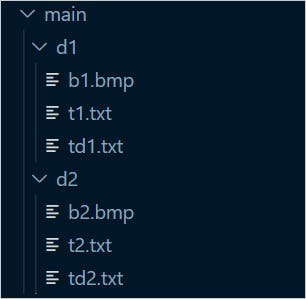
At present the File objects volition have the webkitRelativePath populated as,
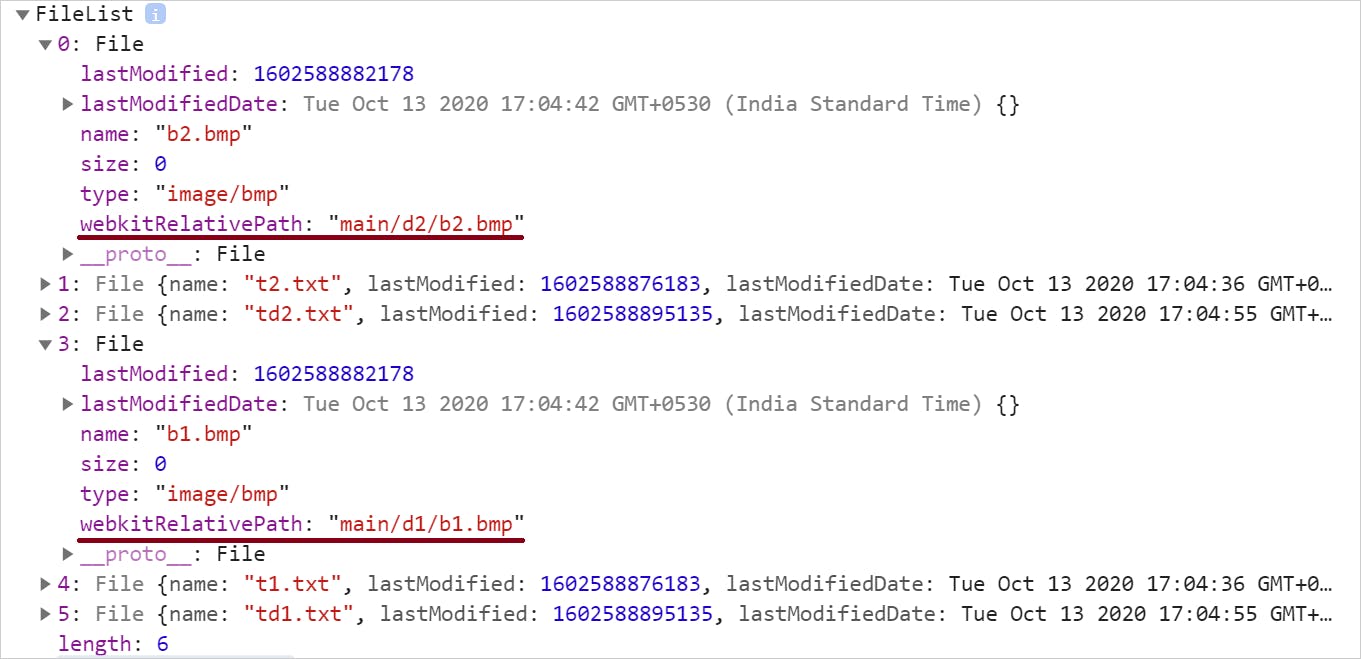
You can use it to render the folder and files in any UI structure of your choice. Use this CodePen to explore further.
9. Permit's elevate, drop and upload
Not supporting a drag-and-drop for file upload is kinda old fashion, isn't it? Allow u.s. see how to achieve that with a few elementary steps.
Starting time, create a drop zone and optionally a department to testify the uploaded file content. We will use an epitome as a file to drag and drop here.
<div id="container"> <h1>Drag & Drop an Image</h1> <div id="drop-zone"> Drop Hither </div> <div id="content"> Your image to announced here.. </div> </div> Get the dropzone and the content areas past their respective ids.
const dropZone = document.getElementById('drop-zone'); const content = document.getElementById('content'); Add a dragover event handler to testify the upshot of something going to be copied,
dropZone.addEventListener('dragover', result => { outcome.stopPropagation(); event.preventDefault(); result.dataTransfer.dropEffect = 'copy'; }); 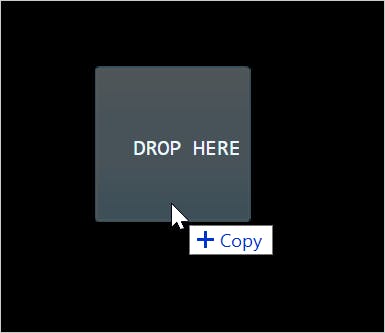
Next, define what we want to do when the image is dropped. We will need a drop event listener to handle that.
dropZone.addEventListener('drop', event => { // Become the files const files = event.dataTransfer.files; // Now nosotros can do everything possible to testify the // file content in an HTML element like, DIV }); Try to elevate and drop an image file in the CodePen example below and see how it works. Do not forget to see the code to render the dropped image also.
10. Handle files with objectURLs
There is a special method chosen, URL.createObjectURL() to create an unique URL from the file. Y'all can too release information technology past using URL.revokeObjectURL() method.
The DOM
URL.createObjectURL()andURL.revokeObjectURL()methods let you lot create simple URL strings that tin exist used to reference any data that can exist referred to using a DOM File object, including local files on the user's calculator.
A uncomplicated usage of the object URL is,
img.src = URL.createObjectURL(file); Use this CodePen to explore the object URL further. Hint: Compare this approach with the approach mentioned in #5 previously.
Conclusion
I truly believe this,
Many times a native HTML feature may be enough for us to deal with the use-cases in hands. I plant, file upload is one such that provides many cool options past default.
Allow me know if this article was useful to yous by commenting below. You may as well like,
- 10 useful HTML5 features, you may not exist using
- I fabricated a photo gallery with CSS animation. Here's what I learned.
- 10 lesser-known Web APIs you may desire to utilise
If information technology was useful to yous, delight Like/Share so that, information technology reaches others as well. Please hit the Subscribe push at the top of the page to go an email notification on my latest posts.
You lot tin @ me on Twitter (@tapasadhikary) with comments, or feel free to follow me.
Source: https://blog.greenroots.info/10-useful-html-file-upload-tips-for-web-developers
0 Response to "Have People Upload Files to Your Website Html"
Post a Comment